Skip to content

How Can I Prepare My Child for Kindergarten Reading Success?
Your Guide to the Best Kindergarten Curriculum
Key Takeaways
- The critical window is birth to age five: Reading readiness begins long before formal schooling, making the preschool years essential for building strong foundations
- Phonemic awareness is the game-changer: The ability to hear and manipulate sounds in words is the single strongest predictor of reading success—stronger than IQ or alphabet knowledge
- Multi-sensory learning creates lasting connections: Children learn best when they see, hear, say, and move simultaneously, creating multiple neural pathways for reading
- One pace doesn’t fit all: The best kindergarten curriculum adapts to your child’s unique learning journey, whether they’re rapidly progressing or need more time
- Early intervention prevents future struggles: Nearly 90% of children with reading difficulties have gaps in foundational skills that could have been addressed before kindergarten
Introduction: The Kindergarten Reading Milestone
Every parent watches their child approach kindergarten with a mix of excitement and nervous anticipation. We wonder: Will they make friends? Will they enjoy school? And perhaps most importantly—will they learn to read?
Reading is the cornerstone of academic success. A child who enters kindergarten with strong foundation skills doesn’t just learn to read—they read to learn from day one. This advantage creates a positive cycle of confidence and achievement that can last throughout their entire educational journey.
But here’s what many parents don’t realize: The most critical window for building reading readiness isn’t during kindergarten—it’s the years before. The foundation for reading success is laid between birth and age five, long before formal education begins.
As a former classroom teacher, reading intervention specialist, and creator of the Jumpstart Kinder program, I’ve spent over 30 years observing a troubling pattern: children who struggle with reading in later grades almost always have gaps in foundational skills. These skills should be firmly in place by the end of first grade, and teaching your child begins long before they start kindergarten. The good news? These gaps are completely preventable with the right kindergarten curriculum designed for early learning.
This guide will show you exactly what your child needs for kindergarten reading success and introduce you to a complete kindergarten curriculum solution that adapts to your unique child—whether they’re progressing rapidly, need more time, or learn differently. Understanding readiness is the first step to ensuring your child will start kindergarten confident and capable.

What Does “Kindergarten Reading Ready” Really Mean?
Before we dive into how to prepare your child, let’s clarify what we’re preparing them for. Kindergarten readiness isn’t about memorizing sight words or reading chapter books. Instead, it’s about building the framework that helps children learn to read successfully.
A truly reading-ready kindergartner can:
- Recognize most uppercase and lowercase letters
- Connect letters with their primary sounds through phonics
- Hear and play with sounds in words (like knowing that “cat” starts with /k/)
- Hold books to read properly and understand that text moves left to right
- Retell simple stories and ask questions about books
- Write their name and some familiar letters and words
- Blend simple sounds together (understanding that /c/ /a/ /t/ says “cat”)
Kindergarten readiness is about foundations, not finished products—but a truly strong foundation can lead to astonishing results. My grandson, following the Jumpstart Kinder system, began reading, spelling, and writing confidently well before his fourth birthday. While each child’s learning journey is unique, his story proves what’s possible when the building blocks are put in place clearly, playfully, and in the right order. These foundational skills become the bedrock for all future academic success.
The Foundational Layer Most Parents, and Programs Miss: Phonemic Awareness
If I could give parents one piece of advice about preparing their child for reading success, it would be this: Strengthen the auditory foundation before connecting it to print. While most programs jump straight to teaching letter names, they often neglect the essential auditory skill that gives letters their meaning: the ability to hear, identify, and manipulate the individual sounds in words (phonemic awareness).
Reading success begins with what the brain hears, not just what the eyes see. When a child can clearly hear that “cat” is made of the sounds /k/ /a/ /t/, then the letters C, A, and T become a logical, decodable map instead of abstract symbols to memorize. In Jumpstart Kinder, we develop this critical auditory skill through reading practice and play-based activities, then immediately connect it to the corresponding letters.

What Is Phonemic Awareness (In Parent-Friendly Language)?
Let me explain this crucial concept without educational jargon.
Imagine your child’s brain is a construction site for reading. Phonemic awareness is the foundation of that building. It has nothing to do with letters on a page—it’s purely about the sounds in spoken words.
Phonemic awareness is the ability to:
- Hear that “cat” and “bat” end with the same sound
- Identify that “mom” starts with the /m/ sound
- Separate the word “dog” into its three distinct sounds: /d/ /o/ /g/
- Blend the sounds /s/ /u/ /n/ together to make “sun”
- Swap the /p/ in “pat” with /m/ to make “mat”
You can do reading practice anywhere, anytime—in the car, at the grocery store, during bath time. No expensive learning resources or materials needed, just your voices. This makes phonemic awareness the most accessible and powerful early literacy tool available to parents.
Why Phonemic Awareness Matters More Than You Think
Research from the National Early Literacy Panel has consistently shown that phonemic awareness is the single strongest predictor of future reading success—stronger than IQ, socioeconomic status, or even knowing the alphabet.
Here’s why:
It’s the Bridge Between Speech and Print: Reading is essentially code-breaking. Your child needs to understand that the squiggles on a page (letters) represent the sounds they already know. Without strong phonemic awareness, letters are just abstract shapes with no connection to language.
It Prevents Guessing: Children without phonemic awareness often guess at words based on the first letter or pictures in picture books. Children with strong phonemic awareness can sound words out systematically using phonics. This difference is crucial for long-term reading independence.
It Makes Spelling Make Sense: Spelling is the reverse of reading—instead of breaking words apart, we put sounds together. Strong phonemic awareness makes spelling rules logical rather than memorization exercises.
It’s Especially Crucial for Struggling Readers: Studies show that nearly 90% of children with reading difficulties have a deficit in phonemic awareness. Addressing this early can prevent years of frustration in formal education.
The heartbreaking reality I’ve witnessed is that children who lack this foundation by the end of first grade face an uphill battle that becomes steeper each year. By third grade, catching up requires intensive intervention. That’s why building this foundation before kindergarten—before formal education even begins—is so critical. The preschool years are your window of opportunity.

The Problem With Most Early Literacy Approaches
Many well-intentioned parents (and even some homeschool curriculum programs) approach early literacy backwards. They start with what’s visible—letters, sight words, writing—before ensuring the auditory foundation is solid.
Common but ineffective approaches include:
1. The Alphabet-Only Approach: Focusing exclusively on letter names without connecting them to sounds. Knowing that “C” is called “see” doesn’t help a child learn to read “cat.”
2. The Sight Word Marathon: Having children memorize sight words as visual shapes without understanding how sounds work within those words. When children memorize without understanding, they become limited readers.
3. The “They’ll Catch Up Later” Mindset: Assuming that readiness will naturally develop without explicit instruction in foundational skills.
4. The Scattered Activities Method: Doing random early learning activities without a logical sequence.
5. The Pressure Cooker Approach: Pushing formal reading practice too early, creating anxiety and resistance.
What’s needed instead is a systematic progression that respects how children’s brains actually learn to read. The best kindergarten curriculum provides this clear, research-based pathway from sounds to words to confident reading.
Introducing a Different Path: Jumpstart Kinder Kindergarten Curriculum
After decades in classrooms and consulting with schools, I created Jumpstart Kinder to solve precisely these problems. This isn’t just another set of activities—it’s a complete kindergarten curriculum designed specifically for preschool children in the critical birth-to-five window, built on phonics and multi-sensory learning. It’s a proven path to reading success that thousands of families have trusted.
What Makes Jumpstart Kinder Different?
1. It Teaches Letters and Sounds Together from Day One
Most programs separate letter names and sounds. Jumpstart Kinder connects them immediately through phonics-based methods. When your child meets the letter “M,” they learn its name, its sound (/m/), and a memorable multi-sensory action all at once. This curriculum gives children the complete picture from the start, building stronger neural connections.
2. We Anchor Learning with Multi-Sensory “Memory Hooks”
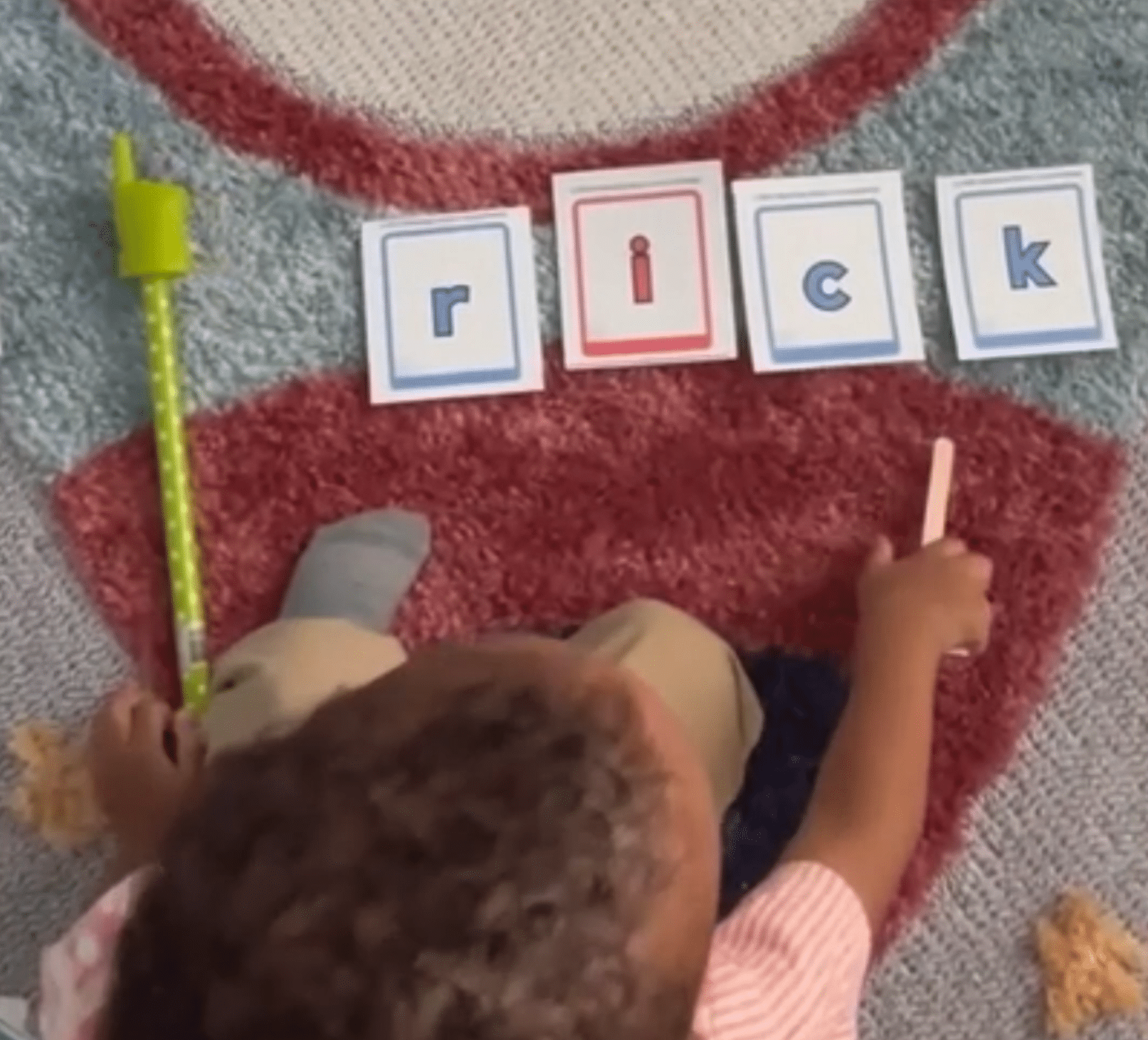
Every letter and sound is introduced through a rich, multi-sensory experience. We see the letter on a color-coded card, hear and say its sound in a fun chant, feel its shape through handwriting practice or tracing in sand, and move with a gesture that embodies the sound. This “see-hear-say-feel-move” method engages multiple learning pathways. It’s a literacy program designed to make learning stick naturally and joyfully.
3. It Follows a Master Sequence, Not a Random Collection
The best kindergarten curriculum follows what I call the “Mastery Architecture”:
- Stage 1: Phonemic Awareness & Letter-Sound Introduction
- Stage 2: Blending (pushing sounds together to make words)
- Stage 3: Reading Decodable Books (applying skills to real books to read)
- Stage 4: Spelling and Writing
Each step builds on the previous one, creating a seamless progression.
4. It Respects the Preschool Attention Span
Lessons take just 3-5 minutes, 2-3 times per day. This isn’t about formal education sessions at a desk—it’s about brief, focused, and joy-filled interactions that fit naturally into your routine. Consistency matters more than duration.
5. It’s Multi-Sensory and Play-Based
Children learn best when they can touch, move, sing, and play. Jumpstart Kinder activities involve movement and song to remember letters and sounds, puppet activities to build vocabulary, and color-coded cards to build words. Learning feels like play, not work. This approach works beautifully for kindergartners and preschoolers alike, meeting them at their developmental level.

The Gift of Pace: How Jumpstart Kinder Adapts to Every Child
One of the most frequent concerns I hear from parents is: “But what if my child is advanced?” or “What if my child needs more time?” Or perhaps most urgently: “What if my child learns differently?”
Traditional classroom instruction and many homeschooling curriculum options force a one-pace-fits-all approach. This leaves both gifted children and those with learning differences frustrated. Jumpstart Kinder was curriculum designed from the ground up to solve this problem.
For the Gifted or Rapidly Progressing Child
Many parents of bright preschool children face a dilemma: their child is clearly ready for more than basic alphabet activities but isn’t developmentally ready for formal reading instruction. They bounce between activities that are too simple or too advanced. The best kindergarten curriculum gives you an open-and-go solution that adapts to rapid progress.
The best kindergarten curriculum solves this by:
Providing a Clear Progression Path: Gifted children can move through the sequence as quickly as they master concepts. If your 4-year-old is blending words by Christmas, the curriculum gives them decodable books ready for the next stage.
Offering Depth, Not Just Speed: Instead of rushing ahead, children can deepen their understanding within each level through challenging sound games and early spelling.
Preventing Boredom with Variety: The multi-sensory approach keeps engaged minds challenged through auditory, tactile, and kinesthetic activities.
Building Confidence Systematically: Jumpstart Kinder’s mastery approach ensures they have every piece of the puzzle, even if they assemble it quickly.

For the Child Who Needs More Time or Learns Differently (Including Dyslexia)
Perhaps you’ve noticed your child struggles with rhyming or remembering letter names despite repeated exposure. Maybe you have a family history of dyslexia. Early intervention is crucial—and Jumpstart Kinder is curriculum designed specifically for this.
Early Identification of Potential Challenges: The program’s structure naturally reveals where a child might be struggling. Difficulty with phonemic awareness activities can be an early indicator that a child needs additional support.
Multi-Sensory Instruction as a Necessity, Not a Luxury: For children with dyslexia, multi-sensory instruction is essential. Jumpstart Kinder’s approach of seeing, hearing, saying, and doing simultaneously creates multiple neural pathways for information.
Mastery-Based, Not Time-Based Progression: There are no deadlines. Your child can spend as long as needed on a single skill until it’s truly mastered.
Breaking Skills into the Smallest Possible Steps: What seems like one skill is broken down into multiple micro-steps, making challenges manageable for children who process information differently.
Building Confidence Through Repetition and Success: The program celebrates small wins. For a child who struggles, completing one 3-minute lesson is a victory.
For Every Child in Between
Most children don’t fit neatly into “gifted” or “struggling” categories. Jumpstart Kinder honors this individuality by:
Letting you follow your child’s interests: If they love a particular activity, you can repeat it. If an activity isn’t connecting, you can modify it or move on.
Allowing natural breaks: Life happens. The curriculum is designed to pause and resume without guilt or falling “behind.”
Adapting to learning style preferences: You’ll naturally discover whether your child learns best through movement, song, touch, or visual cues.
Beyond Kindergarten: How This Foundation Supports Lifelong Learning
The benefits of a strong foundation extend far beyond the kindergarten level:
For School Years: Children who enter kindergarten reading-ready spend less energy on decoding and more on comprehension. They read more, learn more vocabulary, and develop positive associations with learning.
For Children with Learning Differences: Early intervention can significantly reduce the severity of reading difficulties through systematic, multi-sensory instruction.
For Gifted Children: A solid foundation prevents “hollow skills”—surface-level advancement without deep understanding.
For All Children: The confidence gained from mastering reading early becomes part of their identity as learners. They approach new challenges with a “can-do” attitude.

Getting Started: Your First Steps Toward Kindergarten Reading Success
If you’re feeling overwhelmed, take a deep breath. The first step is simply becoming aware of what truly matters.
- Start listening for sounds, not just teaching letters. Play “I spy with my little ear something that starts with /m/” during car rides.
- Read aloud daily, but don’t just read real books—talk about the sounds in words you encounter.
- Choose a systematic approach rather than a collection of random activities.
- Follow your child’s pace, not an arbitrary timeline.
- Celebrate every tiny victory. The first time they identify a rhyme, the first sound they segment, the first letter they connect to its sound—these are all monumental achievements.
Why Jumpstart Kinder Might Be Your Ideal Kindergarten Curriculum Solution
In a crowded market of apps and workbooks, Jumpstart Kinder stands apart as the best kindergarten curriculum for young learners. Born from 30 years in the classroom and as a reading specialist, I’ve successfully taught children to learn to read and have also intervened when they’ve fallen behind. This program captures the essence of that successful classroom system for the critical years before formal instruction.
It’s not just about creating early readers—it’s about creating confident, happy children who see reading as a superpower they’re excited to unlock. Whether your child is eagerly sounding out street signs at age three or needs more time, Jumpstart Kinder meets them where they are and walks alongside them at exactly their pace.
Parents who bought this curriculum often tell me their biggest regret is not starting sooner. The question isn’t whether you should prepare your child for kindergarten reading success. The real question is: Will you choose a path that honors your child’s unique learning journey?
Because every child deserves to enter kindergarten not just ready to learn, but already in love with learning. And that journey begins with you, today, one playful sound at a time.
Ready to take the next step? Explore how Jumpstart Kinder can provide the clear, compassionate, and effective kindergarten curriculum your child needs to build unshakable reading confidence.
Learn more: https://readingreadyfoundations.com/jumpstart-kinder/