Skip to content


What Every Parent Needs to Know About Teaching Kids to Read
If you’ve ever watched your toddler mimic your voice as you read aloud or your baby light up at the sound of a familiar nursery rhyme, you’ve already witnessed the Science of Reading in action.
Today, we know more than ever about how the brain learns to read, thanks to decades of research in neuroscience, linguistics, and education. And this knowledge is not just for teachers—it belongs in every home.
The Science of Reading tells us that reading is not a natural process like speaking. It must be taught, systematically and explicitly, using methods that work with how the brain is wired. When that instruction begins early—in the first five years of life—children gain a powerful head start.
That’s what inspired me to create Jumpstart Kinder, a structured, play-based, parent-friendly Science of Reading Curriculum designed for children from birth to age five.
Jumpstart Kinder is a Science of Reading Curriculum that uses the critical window of early childhood to build phonemic awareness, phonics foundations, vocabulary, and a love of learning—all through short, joyful, daily routines.
For many parents, especially those homeschooling or living in countries where English is a second language, knowing where to start can feel overwhelming. Jumpstart Kinder removes that uncertainty and replaces it with confidence.
What Is “The Science of Reading Curriculum”?
“The Science of Reading” refers to a collective body of evidence explaining how the brain acquires reading skills. It draws from decades of peer-reviewed research and has transformed how leading educators and literacy specialists approach early reading instruction.
A Science of Reading Curriculum emphasizes these key principles:
- Phonemic awareness — helping children hear, identify, and play with individual sounds in words.
- Phonics — teaching the connection between letters and sounds in a clear, sequential order.
- Fluency — practicing reading smoothly and accurately.
- Vocabulary and Comprehension — developing understanding and meaning through conversation and rich language exposure.
- It also entails, Explicit, systematic instruction — not leaving reading to chance, but teaching each skill in a logical progression.
For very young children, 0–5, this means creating a learning environment that is warm, predictable, language-rich, and filled with intentional sound play.
A true Science of Reading Curriculum doesn’t skip foundational skills in favor of memorization or guessing. It builds real readers—children who decode words, understand what they read, and love the process.

How the Brain Learns to Read: Building Pathways Early
From birth to age five, a child’s brain is astonishingly absorbent. By age three, 85% of a child’s brain development has already occurred. This is the window where early literacy experiences lay down the neural pathways that reading depends on.
Here’s what happens inside that little brain:
- Spoken language shapes sound awareness. Nursery rhymes and songs help children notice patterns in language—rhyme, rhythm, and repetition.
- Sound awareness leads to phonemic awareness. As children get older, they can isolate individual sounds: “Cat starts with /k/.”
- Letter-sound mapping seals the connection. When children see that the letter m says /m/, they begin to understand how print works.
- Practice with decodable text builds fluency. Children blend letters into words, words into sentences, and sentences into meaning.
Each step works like a sturdy LEGO block — building on what came before, forming a foundation that supports independent reading.
The Parent’s Role in Early Literacy
Parents are a child’s first and most important teachers. Even if you’ve never taught reading before, you have everything you need to begin.
You can make the most of your child’s early years by focusing on three natural routines:
- Talk: Narrate your day. Describe what you’re doing, what you see, how you feel. Rich oral language builds vocabulary and listening comprehension.
- Play: Use games that involve listening and responding (clapping syllables, sorting objects by beginning sound, singing rhymes).
- Read: Integrate fun, predictable repetition with storybooks, nursery rhymes, and decodable books as children grow.
That’s the essence behind Jumpstart Kinder: making reading readiness effortless and joyful for both parent and child.
Many parents worry about “doing it wrong.” One of my goals with Jumpstart Kinder is to replace that worry with confidence, clarity, and delight.

Jumpstart Kinder: A Science of Reading Curriculum for Ages 0–5
When my daughter asked me to teach her baby (my grandson!) to read, I began with the same Science of Reading principles I’d used for 30 years in classrooms and literacy consulting. What I discovered was how naturally and joyfully children absorb early literacy when it’s woven into daily life.
Seeing his excitement inspired the creation of Jumpstart Kinder, a complete early literacy program that any parent—homeschooling, international, or simply motivated—can use at home.
Here’s how it works.
A Look Inside Jumpstart Kinder
Jumpstart Kinder follows the same research-backed sequence used in top-tier literacy programs, adapted for the home environment.
Program Philosophy
- Explicit and developmentally appropriate instruction. Every lesson tells you exactly what to say, do, and look for.
- Multi-sensory learning. Children move, sing, trace, and listen as they learn.
- Short, consistent sessions. Just 3–5 minutes at a time, 2–3 times a day.
- Flexible pacing. Progress at your child’s speed; repetition is success.
The heart of this Science of Reading Curriculum is that it respects both the research and the child—honoring how young brains grow while keeping learning light, loving, and effective.
What Children Learn
Through structured, playful repetition, children learn to:
- Recognize uppercase and lowercase letters
- Connect letters to their sounds
- Build strong phonemic awareness
- Develop vocabulary, comprehension, and oral language
- Blend sounds to read whole words
- Read decodable books confidently
- Practice beginning spelling and writing
Each concept builds seamlessly to prepare children for independent reading by kindergarten.
The Progression: From Sound to Reading
The Jumpstart Kinder scope and sequence aligns with research from the Science of Reading and progresses naturally through these stages:
- Sound Awareness: Babies and toddlers first hear sounds in songs, clapping games, and read-alouds.
- Letter Recognition: Preschoolers begin connecting those sounds to letter names.
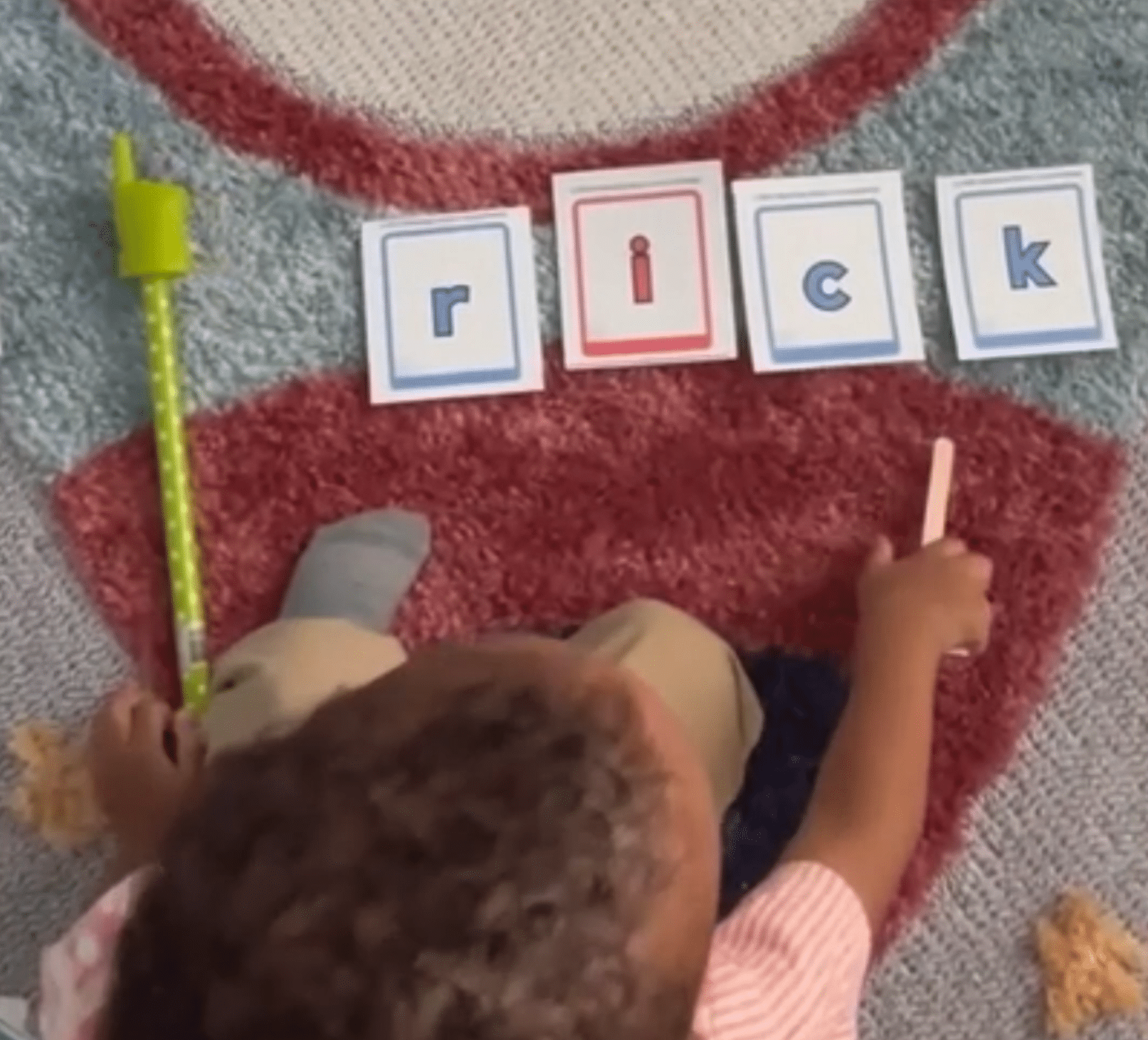
- Phonics Mastery: Children learn how letters combine to make words (CVC blending).
- Reading Application: Early readers apply skills in carefully written decodable books.
- Writing and Spelling Practice: Young learners write letters, then simple words, reinforcing letter-sound knowledge.
Parents receive scripted lessons, videos, and printable materials guiding every step.
Why Phonics-Based Instruction Works
Research consistently shows that early readers thrive when taught with systematic phonics instruction. Phonics gives children the tools to decode any word—not just the ones they’ve memorized.
Phonics turns reading into decoding, a skill; decoding becomes automaticity, which frees the brain to focus on meaning. That’s reading comprehension—and it starts with phonics.
In Jumpstart Kinder, your child practices decoding through tiny, successful steps—building confidence alongside skill.
For international families teaching English, a phonics-based Science of Reading Curriculum is especially powerful. It removes the guesswork from English spelling and gives children a reliable, transferable system.

Learning That Feels Like Play
One of my guiding principles as a master teacher has always been: “Early literacy should feel like love.” Children learn best when they feel safe, celebrated, and engaged.
For example:
- While making pancakes, you can ask your toddler to find all items that start with /p/: pancakes, pan, plate.
- During bath time, you can use letter foam shapes to name sounds and float letters to spell simple CVC words.
- On car rides, you can play “sound spy”: “I spy something that starts with /b/.”
These playful moments keep learning authentic and emotionally positive — exactly what a Science of Reading Curriculum should provide.
Designed for Every Family
Whether you’re a homeschooling parent, an international parent teaching English as a second language, or a busy parent who wants to give your child the best start, Jumpstart Kinder fits your life:
- For homeschoolers: It provides a ready-made literacy curriculum aligned with kindergarten readiness standards.
- For international families: It introduces English phonics clearly and consistently, even if English is not your first language.
- For busy parents: Lessons fit into daily life — no need for long prep or teaching experience.
Everything is parent-friendly, expert-guided, and paced to match your child’s current level.
What Kindergarten-Ready Really Means
Parents often ask, “What should my child know before kindergarten?” The answer isn’t a checklist—it’s a foundation.
By completing Jumpstart Kinder, your child will:
✔ Recognize uppercase and lowercase letters ✔ Produce letter sounds accurately ✔ Blend simple CVC words ✔ Show phonemic awareness skills ✔ Demonstrate early comprehension and vocabulary ✔ Approach reading with confidence and curiosity
These outcomes reflect the true Science of Reading Curriculum — not rushing a child, but preparing them thoroughly, joyfully, and at the right pace.
Confidence for Both Parent and Child
The best part? You don’t need a teaching background to succeed.
Each Jumpstart Kinder lesson is fully guided, with simple scripted lessons, audio support, and step-by-step video instruction. You’ll always know what to say, what to do, and how to respond to your child’s progress.
When a child feels secure and celebrated during learning, motivation skyrockets. And when parents feel supported by a Science of Reading Curriculum that’s been tested in real classrooms and real homes, confidence follows naturally.
From My Classroom to Your Living Room
Over my 30 years in education, as a classroom teacher, reading specialist and regional literacy consultant, I’ve worked with thousands of children and their families. I’ve seen the full spectrum—from children who learned to read with ease to those who struggled silently for years.
I’ve seen firsthand what happens when foundational skills are missed: older students who avoid reading, hide their struggles, and begin to believe they simply aren’t smart. It breaks my heart every time.
But my heart always returns to the beginning — those precious first steps when a child blends their first word and looks up with wide eyes, astonished that they just read.
That moment is priceless. And now, with Jumpstart Kinder, every parent can capture it.
Ready to Jumpstart Your Child’s Reading Journey?
If you believe learning to read should be motivating, research-based, and bonding for your whole family, Jumpstart Kinder was made for you.
Join families around the world who are using the Science of Reading Curriculum at home — from the very first lullaby to the very first book.
You’ll gain:
- A step-by-step roadmap for ages 0–5
- Printable lessons and audio and video support
- My exclusive Blending Cards for hands-on phonics practice
- Access to progress trackers, stickers, multi-sensory activities, alphabet tracing pages, and more
- ABC Poster, nursery rhymes, and early decodable readers
Let’s build bright beginnings together.
Visit readingreadyfoundations.com to learn more and begin your Jumpstart Kinder journey today.
Take the next step in your child’s literacy journey with confidence
Download My Free Reading Ready for Kinder Parent Guide
About the Author
L.T. Lyles, M.Ed., is the founder of Reading Ready Foundations and creator of Jumpstart Kinder. With over 30 years of experience as a classroom teacher, reading interventionist, and literacy consultant—she is passionate about equipping families with the tools to build confident readers from the ground up.