Skip to content


If your preschooler loves to move, touch everything, and sing the same song 20 times in a row, you already have a front-row seat to why multisensory phonics instruction works so well. When children can see, hear, say, and physically feel sounds and letters, they remember them more easily and feel more confident using them. These kinds of hands-on activities build the phonics skills that make learning to read feel natural instead of stressful.
This parent-friendly guide will walk you through 10 multisensory phonics activities for your preschooler that you can do at home with simple materials. Along the way, I’ll show you how these engaging activities fit into a bigger, research-based plan for teaching reading and writing—like the one I map out in my post, “The Ultimate Guide to Choosing a Preschool Homeschool Curriculum That Actually Builds Readers.”
These phonics activities are designed to help children build a solid foundation for reading and spelling in preschool and kindergarten.

Why Multisensory Phonics Helps Preschoolers Learn
Phonics is about teaching children how letters and groups of letters connect to sounds in spoken language. Multisensory phonics simply means we teach these connections using more than one sense at a time:
- Visual — seeing the letter or letters and words
- Auditory — hearing and saying the sound
- Kinesthetic/tactile — moving the body or using touch (tracing, building, tapping, even shaving cream writing)
From the lens of the science of reading, effective phonics instruction helps children link sounds in words to print in a clear, systematic way. When preschoolers connect phonics concepts using multiple senses, it:
- Improves memory and recall of letter–sound relationships
- Increases engagement and attention (especially for wiggly kids who need kinesthetic input)
- Builds stronger decoding skills for later reading and spelling
In other words, multisensory phonics activities for your preschooler are not just cute extras—they’re a powerful way to help children build literacy skills and a solid foundation for reading from the very beginning.
A Few Tips Before You Start
Before we jump into the 10 activities, keep these simple guidelines in mind:
- Aim for short sessions: 3–10 minutes is plenty for most preschoolers.
- Keep it fun and low-pressure: The goal is joyful practice, not perfection.
- Always say the sound, not just the letter name (for example, “/m/” instead of “em”) so phonics instruction is focused on usable phonics skills.
- Follow your child’s lead: If they’re tired or frustrated, take a break and try again later.
You don’t need to do all 10 multisensory phonics activities in one day. Think of them as a toolbox of games and hands-on ideas you can pull from throughout the week to help kids grow confident with sounds in words and simple CVC words.
1. Sand (or Salt) Tray Letter Writing
Skills: Letter formation, letter–sound connections, tactile learning
What you need:
- A shallow tray or baking dish
- Sand, salt, sugar, rice, or even a thin layer of shaving cream
- Letter cards (you can write letters on index cards or sticky notes)
How to do it:
- Pour a thin layer of sand, salt, or shaving cream into the tray.
- Show your child a letter card and say the sound: “This is m. It says /m/.”
- Use your finger to slowly write the letter in the tray while you say the sound.
- Invite your child to trace the letter in the tray while saying the sound out loud.
Why it works: Your preschooler is seeing the letter, hearing and saying the sound, and feeling the shape of the letter with their finger—all at the same time. This simple hands-on activity strengthens phonics skills in a way worksheets alone never could.
2. Move-and-Say Letter Paths
Skills: Letter recognition, letter–sound connections, gross motor
What you need:
- Painter’s tape or sidewalk chalk
How to do it:
- Use tape on the floor (or chalk outside) to make large letters—one per “station.”
- Choose 3–5 letters your child is working on.
- Call out a sound: “Find the letter that says /s/!”
- Your child runs, hops, or tiptoes to the correct letter and says the sound as they stand on it.
Variations:
- Have them trace around the letter shape with their feet.
- Call out, “Walk like a bear to the /m/!” or “Hop like a bunny to the /t/!”
This is one of my favorite multisensory phonics activities for your preschooler because it channels their natural need to move into meaningful learning. It’s perfect for preschool and kindergarten learners who need kinesthetic input to lock in those letter–sound connections.

3. Sound Sorting with Toys
Skills: Initial sound awareness, sound discrimination, early phonics concepts
What you need:
- A few baskets, bowls, or labeled areas on the floor
- Small toys or household objects (car, spoon, button, doll, mug, magnetic letters, etc.)
- 2–3 letter cards for the sounds you’re focusing on
How to do it:
- Place letter cards in front of each basket (for example: “m,” “s,” and “t”).
- Say the sound of each letter with your child: “/m/, /s/, /t/.”
- Lay out the toys and name them: “car, sock, mug, turtle…”
- Invite your child to listen for the first sound and sort: “Sock starts with /s/. It goes in the /s/ basket.”
You’re helping your child hear sounds in words, say them, see the letters, and physically move the objects to match—all in one hands-on game. These kinds of phonics activities help kids connect sounds in a word to print in a playful way.
4. Playdough Letter Building
Skills: Letter recognition, letter formation, fine motor strength
What you need:
- Playdough or modeling clay
- Letter cards or a printed alphabet
How to do it:
- Choose one or two letters at a time.
- Show your child the letter and say: “This is ‘a.’ It says /ă/ like in ‘apple.’”
- Roll the playdough into “snakes” together.
- Help your child build the letter shape on top of the card while saying the sound.
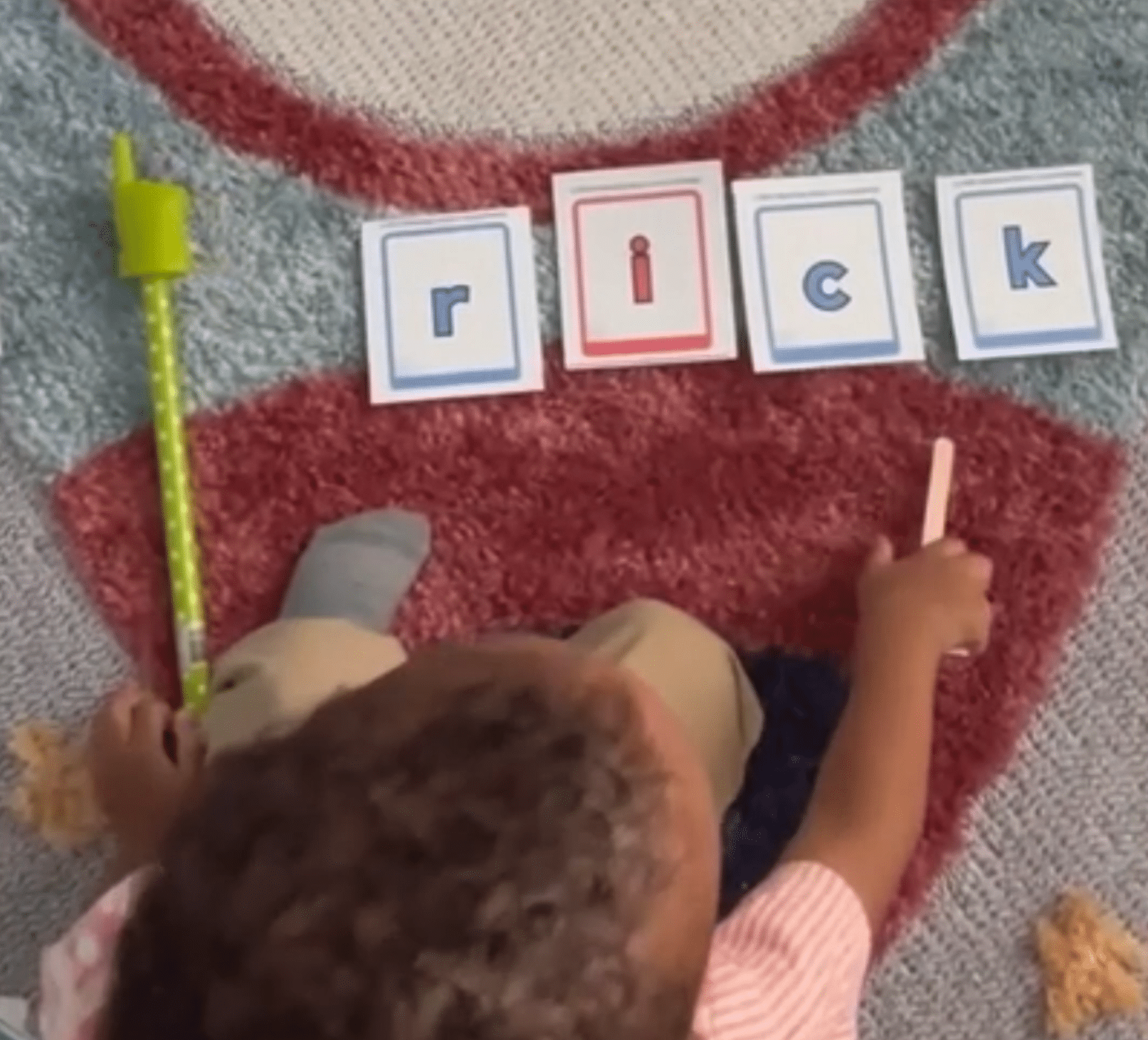
To extend, you can make simple CVC words together once they know several letters: “Let’s build ‘m-a-p’ and blend it: /m/ /ă/ /p/… map!”
Playdough is a classic for multisensory phonics activities for your preschooler because it strengthens hands for writing while also reinforcing letter–sound connections through hands-on exploration.
5. Tap, Clap, and Blend
Skills: Phonemic awareness (blending sounds into words), early phonics skills
You can do this one anywhere—no materials needed.
How to do it:
- Tell your child: “I’m going to say a word in slow sounds. Your job is to guess the word.”
- Tap your knee (or clap) for each sound: “/m/ (tap), /ă/ (tap), /p/ (tap). What word?”
- Child: “map!”
- Switch roles and let your child be the “robot” saying the sounds while you blend.
You’re training your child’s ears to push sounds together, which is a crucial step before reading printed letters and words. Understanding the sounds in a word like “map” or “sun” is what makes later phonics instruction and decoding CVC words feel easier and more natural.
6. Sky Writing and Air Tracing
Skills: Letter formation, large motor memory, letter–sound links
What you need:
- Just your finger and some imagination
How to do it:
- Choose a letter and say its sound: “This is ‘t.’ It says /t/.”
- Have your child stand up and write the letter in the air using their whole arm, as big as they can.
- As they “sky write,” ask them to say the sound each time: “/t/, /t/, /t/.”
Variation:
- Pretend your finger is a paintbrush, wand, or rocket writing the letter across the sky.
This kind of full-body, kinesthetic movement helps the brain remember the shape and sound of the letter more strongly. It’s another example of hands-on activities that make phonics instruction feel like play.

7. Rainbow Writing Words
Skills: Letter formation, word spelling, visual memory, reading and writing connection
What you need:
- Paper or a whiteboard
- Crayons or markers in several colors
How to do it:
- Choose one simple word that uses letters your child already knows (like “sat” or “map”).
- Write the word once and read it together, sounding it out: “/s/ /ă/ /t/, sat.”
- Have your child trace over the word in one color while saying each sound.
- Then trace again in another color, and another, creating a “rainbow” of repeated practice.
This activity lets kids see, say, and write the same word multiple times without it feeling like dull drill. It strengthens phonics skills, supports both reading and spelling, and shows how phonics concepts live inside real words.
8. Sensory Letter Hunts
Skills: Letter recognition, sound recall, gross motor
What you need:
- Sticky notes or index cards with letters written on them
How to do it:
- Write 5–10 letters on separate cards that your child is learning.
- Hide them around a room (on the couch, door, bookshelf, etc.).
- Give your child a “mission”: “Find all the letters that say /m/ and /s/!”
- Each time they find a letter, they say the sound, and you can prompt a word: “/m/ like ‘mom’; /s/ like ‘sun’.”
You can turn this into a treasure hunt with a small reward at the end if you’d like, but the real treasure is the repeated, playful exposure to letter–sound connections. It’s one of those phonics activities to try when you want games and hands-on learning rather than seatwork.
9. Sound Cups or Jars
Skills: Initial sound sorting, vocabulary, listening, sounds in words
What you need:
- Paper cups or small jars
- Sticky labels
- Small objects (buttons, blocks, toy animals, etc.)
How to do it:
- Label each cup with a letter (m, s, t, etc.).
- Say the sound of each letter together.
- Place a pile of objects on the table.
- Ask your child to say the names of the objects and drop them into the cup that matches the first sound: “Monkey” goes in the /m/ cup, “sock” in the /s/ cup, and so on.
This is another simple but powerful example of multisensory phonics activities for your preschooler—they are touching, seeing, and hearing all at the same time, which strengthens their understanding of how sounds in a word connect to print. These hands-on activities quietly build important literacy skills.
10. Read, Point, and Act It Out
Skills: Phonics in context, fluency, comprehension, language and literacy skills
What you need:
- Very simple decodable books or short phrases you write yourself (like “Sam sat.” “Mim naps.”)
How to do it:
- Choose a very short sentence that uses letters and sounds your child has practiced (for example: “Sam sat.”).
- Point under each word as you slowly sound it out together: “/S/ /ă/ /m/, Sam. /s/ /ă/ /t/, sat.”
- After reading, let your child act it out—they can pretend to be Sam sitting, napping, or jumping.
- Reread the sentence while they act; then switch roles.
This activity connects phonics practice to real reading and meaning, which is the ultimate goal of phonics instruction. Children begin to see that all of the multisensory phonics work leads to something exciting: understanding stories and text and growing real reading and writing confidence.
For more on choosing decodable books and integrating them into a full preschool reading path, you can check the section on decodable readers in “The Ultimate Guide to Choosing a Preschool Homeschool Curriculum That Actually Builds Readers.”

How These Activities Fit Into a Bigger Reading Plan
It’s easy to see these 10 multisensory phonics activities for your preschooler and think, “Great, I’ll just do these and we’re set.” But the most powerful results happen when:
- Activities follow a logical sequence (sounds and letters → blending → reading CVC words → writing).
- Phonics skills are reviewed and revisited over time.
- Phonics instruction is connected with oral language, vocabulary, and comprehension.
That’s what a strong preschool homeschool curriculum should do for you: give you a roadmap so you’re not guessing what to teach next or wondering if you’re leaving gaps. When phonics activities are woven into a clear plan, they truly help children build a solid foundation for reading.
In my post, “The Ultimate Guide to Choosing a Preschool Homeschool Curriculum That Actually Builds Readers,” I outline exactly what to look for in a program:
- Explicit phonemic and phonological awareness instruction
- Systematic, multisensory phonics instruction that uses plenty of hands-on experiences
- Decodable reading practice that connects sounds in words to print
- Short, parent-friendly lessons that fit your real life
If you’ve enjoyed these 10 phonics activities and you’re wondering how to build them into a complete plan from now through kindergarten, that guide is the perfect next step.
A Note About My Background (Why You Can Trust This Approach)
I’m L.T. Lyles, M.Ed., the founder of Reading Ready Foundations and creator of Jumpstart Kinder. For over 30 years, I’ve worked as:
- A kindergarten and first-grade teacher
- A reading intervention specialist
- A regional literacy consultant
During those years, I’ve supported struggling readers in upper grades and traced their challenges back to missing early skills—especially in phonological awareness and phonics. I’ve also seen how multisensory phonics instruction, paired with a clear, structured plan, can transform a child’s learning-to-read journey.
That’s why I’m so passionate about equipping parents with tools that are:
- Research-informed and aligned with the science of reading, but easy to use at home
- Short, playful, and realistic for busy families
- Focused on building strong, lasting phonics skills and overall literacy skills
Your Next Step
You don’t have to do everything at once. Start by choosing 1–2 of these multisensory phonics activities for your preschooler this week and weaving them into your routines as simple, hands-on activities.
When you’re ready to move from “great activities” to a full, step-by-step roadmap that takes your child from sounds in words to confident reading and spelling, head over to my post:
“The Ultimate Guide to Choosing a Preschool Homeschool Curriculum That Actually Builds Readers.”
It will show you how to:
- Choose or evaluate a curriculum that will truly teach phonics
- Avoid common pitfalls that leave gaps in phonics concepts
- Support your preschooler with a calm, confident plan as they are learning to read
You are absolutely capable of helping your child become a strong, engaged reader—one multisensory, hands-on step at a time.
Take the next step in your child’s literacy journey with confidence
Download My Free Reading Ready for Kinder Parent Guide
L.T. Lyles, M.Ed., is the founder of Reading Ready Foundations and creator of Jumpstart Kinder. With over 30 years of experience as a classroom teacher, reading interventionist, and literacy consultant—she is passionate about equipping parents with the tools to build confident readers from the ground up.